Thicker Semen: What Affects Consistency & Appearance?
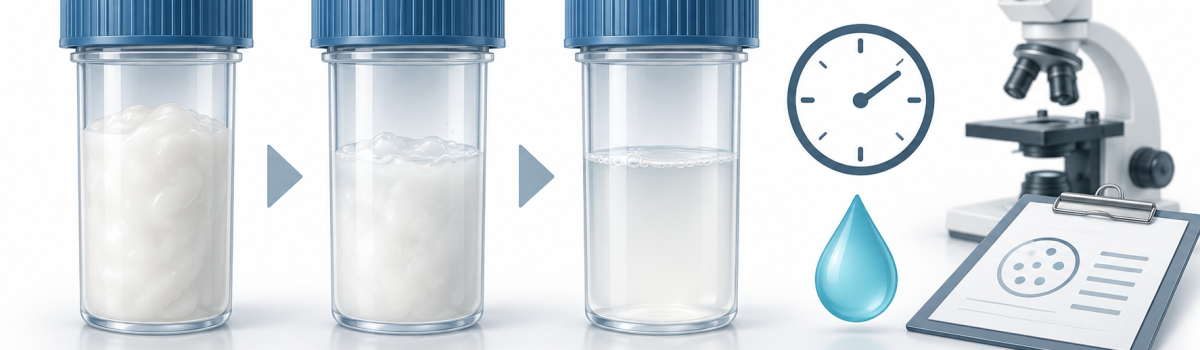
Quick answer: Semen naturally changes in thickness and appearance. Fresh semen is often gel-like at first and normally liquefies within roughly 15–30 minutes. Hydration, time since ejaculation, infection, prostate or seminal-vesicle function, and other medical factors can affect consistency.
Important: Thicker semen does not automatically mean higher sperm count, better fertility, more semen volume or stronger orgasms.
What Does “Thicker Semen” Mean?
People usually use “thicker semen” to describe semen that looks more viscous, gel-like, clumpy or less watery than usual. That appearance can vary from one ejaculation to another and is not, by itself, a reliable measure of fertility or sexual health.
Immediately after ejaculation, semen normally coagulates into a thicker gel. It then undergoes liquefaction, becoming more fluid as enzymes from the prostate act on the seminal fluid. Because semen changes over time after ejaculation, comparing samples at different time points can be misleading.
What Affects Semen Thickness?
Time Since the Last Ejaculation
A longer abstinence interval can change ejaculate characteristics, including volume and concentration. Semen may appear thicker after a longer interval, but more abstinence is not automatically better for fertility or sperm quality.
Hydration
Hydration can influence body-fluid concentration, but there is no strong evidence that simply drinking more water reliably turns “thin” semen into “thick” semen in a clinically meaningful way. Staying adequately hydrated is reasonable general advice, but dramatic claims should be avoided.
Normal Liquefaction
Semen is supposed to change consistency after ejaculation. A sample that initially looks thick may be completely normal if it liquefies within the expected time.
Prostate and Seminal-Vesicle Function
Most semen volume comes from accessory glands, especially the seminal vesicles and prostate. Changes in their secretions can affect semen characteristics, including volume, viscosity and liquefaction.
Infection or Inflammation
Genital-tract infection or inflammation can sometimes alter semen appearance or consistency. Persistent changes accompanied by pain, burning, fever, foul odor or blood in semen deserve medical evaluation.
Does Thicker Semen Mean More Sperm?
No. Visual thickness cannot tell you sperm concentration, total sperm count, motility or morphology. Those require a semen analysis.
This distinction matters because semen quality is better assessed using laboratory measurements than appearance alone. For non-supplement strategies aimed at measurable semen parameters, see Increase Semen Quality.
Does Thicker Semen Mean More Semen Volume?
No. Thickness and volume are separate characteristics. A small amount of semen can look thick, while a larger amount can look relatively fluid.
If your goal is specifically to increase the amount of ejaculate, see our Semen Volume guide or How to Increase Ejaculate Volume.
Can Foods or Supplements Make Semen Thicker?
There is no well-established supplement or food that can be assumed to reliably increase semen viscosity in healthy men. Many products marketed for “thicker loads” actually target semen volume, sperm parameters or general male sexual wellness instead.
That is why product claims should be matched to the outcome actually studied. A supplement with evidence related to semen volume should not automatically be described as proven to make semen thicker.
Looking for higher ejaculate volume rather than thicker consistency?
Our comparison ranks semen-volume supplements based on finished-product evidence, formula transparency, value and claim quality.
What About Semenax?
Semenax has product-specific research related primarily to ejaculate volume and subjective sexual outcomes. We do not consider that evidence proof that Semenax makes semen thicker, because semen viscosity was not the central claim we use to evaluate the product.
If your goal is more ejaculate rather than a change in consistency, Semenax is more relevant to that question.
When Is Thick or Clumpy Semen a Concern?
Occasional variation is common. Consider medical evaluation if a change is persistent or accompanied by:
- pain with ejaculation
- blood in semen
- burning with urination
- fever or pelvic pain
- foul-smelling discharge
- fertility concerns
- semen that consistently fails to liquefy
A clinician or fertility specialist can order semen analysis and evaluate possible infection, inflammation or reproductive-tract issues.
Thicker Semen vs. Bigger Loads
These are different search intents. “Thicker semen” describes consistency or viscosity. “Bigger loads” generally means a larger volume of ejaculate.
For volume-focused strategies, see Bigger Loads: How to Increase Ejaculate Volume and Semen Production Supplements.
Bottom Line
Semen thickness varies naturally and often changes after ejaculation as semen liquefies. Appearance alone cannot tell you sperm count, fertility or overall semen quality. There is no strong basis for promising that a specific food or supplement will reliably make semen thicker. Persistent changes, symptoms or fertility concerns are better evaluated medically than judged by appearance.
For adjacent intents, use Semen Quality Supplements for supplement evidence, Increase Semen Quality for non-supplement factors, and Semen Volume for the broader hub.
Thicker Is Not Automatically Better
Strongest evidence: Clinical evaluation considers liquefaction, viscosity and sperm parameters; appearance alone is weak evidence.
Limited evidence: Hydration and abstinence can change appearance without creating a durable improvement.
Unsupported: Thicker semen is not proof of high testosterone, sperm count or superior fertility.
Practical decision framework
Persistent clumping, delayed liquefaction, pain, odor or fertility concerns justify testing rather than cosmetic experimentation.
Useful comparisons: semen-quality evidence, semen-volume guide, ejaculation-force guide.