How to Straighten a Curved Penis: Causes, Treatment & When to See a Urologist
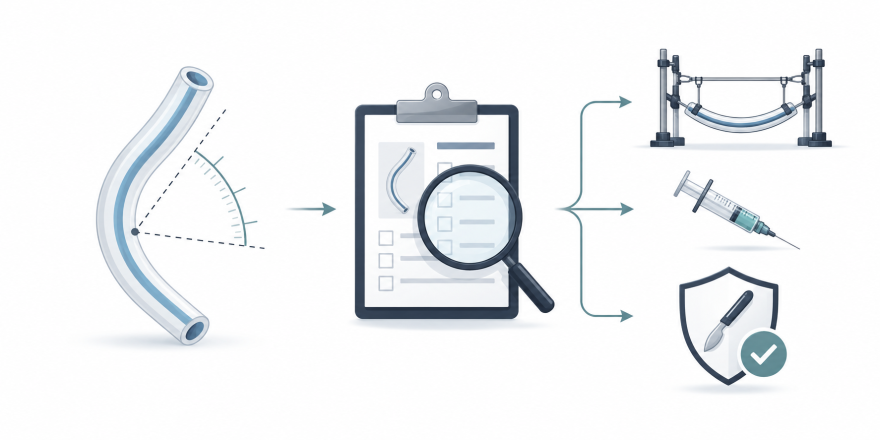
A curved penis is not always a disease, and the right treatment depends on why the curve exists. Some men have congenital curvature that has been present since puberty. Others develop a new curve later in life because of Peyronie’s disease, trauma or another condition.
The most important first step is determining whether the curvature is lifelong and stable or newly acquired and changing. New curvature, pain, shortening or a palpable plaque should be evaluated by a urologist.
Congenital curvature vs Peyronie’s disease
Congenital penile curvature is usually present from adolescence and is not caused by scar tissue. Peyronie’s disease is acquired and involves fibrous plaque that can create new curvature, narrowing, shortening, pain or erectile difficulty.
If the curve appeared later in life, start with our Peyronie’s disease treatment guide.
Can traction straighten a curved penis?
Traction has published evidence in Peyronie’s disease. Randomized and controlled studies of specific devices have reported average reductions in curvature along with length preservation or gain. The degree of improvement varies, and complete straightening is not guaranteed.
See penile traction for Peyronie’s disease for the clinical evidence and our Peyronie’s traction-device comparison for product-level differences.
What about manual bending or stretching?
Do not aggressively bend or stretch a curved penis on your own. Manual force is not equivalent to a studied traction protocol and can cause injury. If modeling or stretching is appropriate, it should be discussed in the context of a diagnosed condition and a specific treatment plan.
Injections for Peyronie’s curvature
Selected men with Peyronie’s disease may be candidates for injections into the plaque. Collagenase clostridium histolyticum is FDA approved for certain adults with clinically significant curvature and a palpable plaque. It is administered by trained clinicians and is often combined with modeling or traction.
When surgery is considered
Surgery can provide the most substantial straightening for severe stable deformity, but it carries tradeoffs. Procedures may shorten the longer side, lengthen the shorter side with grafting, or involve a penile implant when erectile dysfunction is also severe. Surgery is generally considered after the condition has stabilized.
Does every curve need treatment?
No. Mild stable curvature that does not cause pain, distress or difficulty with intercourse may not require treatment. Treatment is usually driven by function, symptoms, progression and patient goals rather than the presence of any curve at all.
When to see a urologist
Seek medical evaluation for a new or worsening curve, painful erections, a palpable lump, hourglass narrowing, shortening, erectile dysfunction, difficulty with penetration or concern after penile injury. Sudden changes should not be managed as a cosmetic self-treatment problem.
Our Curvature Decision Framework
Strongest evidence: Disease-specific clinical evidence supports traction, collagenase injections for eligible plaques and surgery for selected stable cases.
Limited evidence: The appropriate option depends on curvature severity, erectile function, plaque characteristics, disease phase and treatment goals.
Unsupported: Forceful home bending, unmonitored stretching or a supplement cannot be assumed to remodel scar tissue safely.
Practical decision framework
A mild stable curve without pain or functional difficulty may need no treatment. New pain, a changing bend, shortening or intercourse difficulty warrants urologic assessment. The decision is not simply “traction versus surgery”; diagnosis and disease phase come first.
Useful comparisons: treatment overview, traction evidence, device comparison.
References
Mayo Clinic: Peyronie’s disease diagnosis and treatment
Randomized controlled trial of traction therapy for Peyronie’s disease