Penile Traction Devices & Therapy: Complete Evidence Guide
Penile traction therapy uses a mechanical device to apply controlled, sustained tension to the penis over repeated sessions. It has been studied both for cosmetic lengthening and for medical conditions such as Peyronie’s disease and penile shortening.
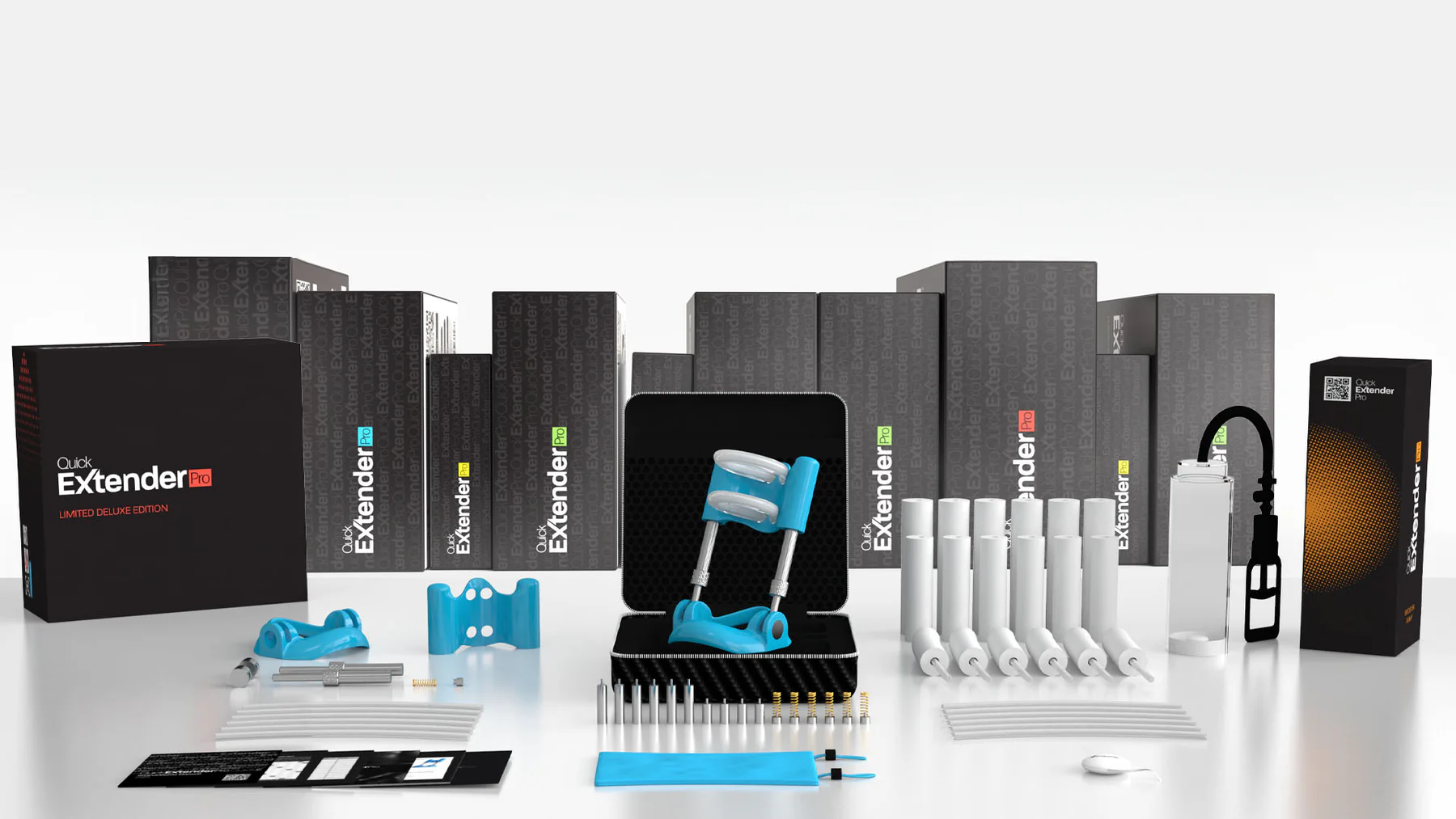
The evidence is not equally strong for every use. This guide separates clinical traction therapy from consumer extender marketing and explains what current studies actually show, how treatment protocols differ, and where expectations should remain conservative.
What is penile traction therapy?
Penile traction therapy, or PTT, uses a traction device to place the penis under longitudinal tension. Depending on the device, attachment may be via a strap, noose, vacuum cap or other support system. The goal is gradual tissue adaptation rather than temporary engorgement.
The same broad mechanism is used by many consumer penis extenders, but medical traction systems may differ in design, recommended session length, tension and intended condition.
What is penile traction used for?
Traction has been studied for several different goals: increasing penile length in men seeking cosmetic enhancement, reducing curvature in Peyronie’s disease, preserving or restoring length after penile shortening, and rehabilitation in selected clinical contexts. These uses should not be blended together because the patient populations and treatment outcomes differ.
Evidence for increasing penile length
Systematic reviews of men seeking penile enhancement have found that traction devices can produce modest length gains in some studies, typically after months of regular use. However, the evidence base is limited by small sample sizes, different devices, inconsistent protocols and variable measurement methods.
European Association of Urology guidance allows penile traction therapy to be considered as a conservative option for increasing length, but rates the recommendation as weak because the studies are heterogeneous and the overall evidence quality is limited.
For a broader comparison with pumps, pills, stretching and surgery, see Penis Enlargement Methods: What Actually Works?
Evidence for Peyronie’s disease
Peyronie’s disease is a separate clinical indication in which scar tissue can cause curvature, shortening, pain or erectile difficulty. Multiple studies have evaluated traction for curvature reduction and length preservation or restoration in this population.
Some modern devices have been studied using shorter daily protocols than traditional extenders. Results reported in Peyronie’s trials should not automatically be generalized to healthy men seeking cosmetic enlargement. See our dedicated guide to penile traction for Peyronie’s disease.
How long does traction take to work?
There is no single universal protocol. Traditional extenders may be prescribed or marketed for several hours per day, while some condition-specific devices use shorter sessions. Study durations commonly run for several months. Adherence matters because traction works through repeated exposure over time rather than a one-time treatment.
Our penile traction results guide compares treatment duration, measured length changes, curvature outcomes and study populations side by side.
Medical traction devices vs consumer penis extenders
Consumer extenders are usually sold for enlargement and may emphasize comfort, wear time, package contents and price. Medical traction devices are more likely to be positioned around a defined clinical indication, published studies or clinician-guided use.
The distinction matters because a study showing traction is effective in a particular condition does not prove that every consumer extender has equivalent clinical validation. Product-specific evidence should be evaluated separately from evidence for the overall traction mechanism.
How much tension is appropriate?
More tension is not automatically better. Excess force can increase pain, numbness, swelling or tissue injury and may reduce adherence. Follow the device-specific protocol and do not exceed recommended tension or wear time in an attempt to accelerate results.
Safety and possible side effects
Reported problems can include discomfort, skin irritation, bruising, glans pain, temporary numbness and swelling. Stop use and seek medical advice for persistent pain, significant discoloration, loss of sensation, injury or worsening symptoms.
Men with new curvature, suspected Peyronie’s disease, prior penile surgery, erectile dysfunction, bleeding disorders or altered sensation should discuss traction with a urologist before starting a consumer protocol.
Traction vs manual stretching
Mechanical traction and manual stretching are not interchangeable. A device is designed to provide controlled tension for a defined duration, while hand-applied stretching varies greatly in force and consistency. Clinical evidence for manual enlargement exercises is much weaker. See Penis Stretching: Methods, Evidence & Safety.
Traction vs vacuum pumps
Vacuum devices increase blood filling and can temporarily change penile size while in use. They have established medical uses, particularly for erectile dysfunction, but they are not proven to create durable enlargement. Traction instead aims for gradual tissue remodeling under mechanical tension.
Choosing a traction device
For cosmetic use, our Best Penis Extenders comparison evaluates individual products. For men specifically researching curvature, the more relevant path is our Best Traction Device for Peyronie’s Disease comparison.
Regardless of purpose, compare product-specific evidence, attachment design, comfort, recommended wear time, warranty, return policy and whether claims are supported by research on the actual device.
How We Read Traction Research
Strongest evidence: We prioritize prospective human studies reporting measured length or curvature change, protocol duration, adherence and adverse events.
Limited evidence: Results from one device or one clinical population support traction as a category more readily than they prove identical results for every extender.
Unsupported: More tension, more hours or a higher advertised maximum does not automatically mean faster or larger gains.
Practical decision framework
Read every result as a package: device, population, wear time, study length and outcome. A two-hour Peyronie’s protocol cannot be casually converted into an elective enlargement promise, and a six-month length study does not guarantee the same response in every user.
Useful comparisons: results interpretation, ranked devices, manual stretching comparison.
Bottom line
Penile traction is one of the few nonsurgical approaches with published evidence for modest length gains and has a distinct medical role in Peyronie’s disease. The limitations are important: treatment takes time, adherence matters, study quality varies, and category-level evidence should not be treated as proof that every commercial extender produces the same outcome.
References and guidance
European Association of Urology: penile size abnormalities and conservative treatment
Penile traction therapy and Peyronie’s disease: clinical evidence review