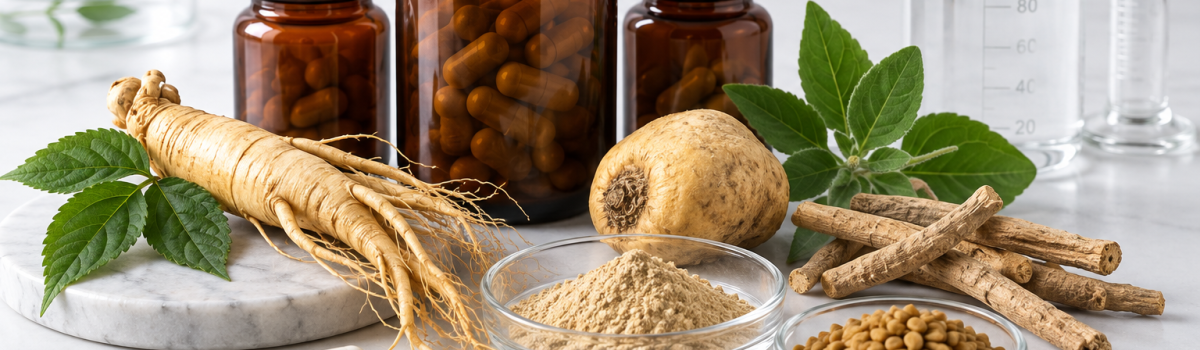
Male Enhancement Ingredients: What the Evidence Actually Supports
Quick answer
No natural ingredient has strong evidence for every outcome marketed as “male enhancement.” The most defensible evidence is narrow and goal-specific: L-arginine has some human evidence for mild-to-moderate erectile dysfunction, while Panax ginseng and L-citrulline have limited but potentially relevant evidence. Evidence for libido-focused ingredients such as maca, fenugreek, and ashwagandha is preliminary or inconsistent. No pill ingredient has reliable evidence that it permanently enlarges the penis.
“Male enhancement” is a marketing category, not a medical diagnosis. It can refer to erection quality, sexual desire, testosterone, fertility, ejaculation, stamina, or permanent penis enlargement. Those outcomes involve different biology, so an ingredient that may help one does not automatically help the others.
This guide evaluates ingredients by the outcome actually studied in humans. We give the most weight to randomized controlled trials and systematic reviews, less weight to small or uncontrolled studies, and almost no weight to animal research, traditional use, testimonials, or a plausible mechanism by itself.
Our evidence framework
| Evidence level | What it means | How to use it |
|---|---|---|
| Most promising | Human trials or reviews show a possible benefit for a defined outcome, although the evidence is still weaker than for approved medical treatment. | Reasonable to discuss with a clinician when the studied dose and intended outcome match. |
| Limited | Small trials, mixed findings, formulation-specific results, or indirect evidence. | Treat as uncertain—not as proof that a commercial blend works. |
| Unsupported | Claims rely mainly on animal studies, tradition, mechanisms, testimonials, or doses unlike the finished product. | Do not pay a premium for the claim. |
Ingredients with the most relevant human evidence
L-arginine: some evidence for erectile function
L-arginine is an amino acid used to produce nitric oxide, a signaling molecule involved in blood-vessel relaxation. A 2019 systematic review and meta-analysis of 10 randomized trials involving 540 men found that oral arginine—generally 1,500 to 5,000 mg daily—improved several erectile-function outcomes compared with placebo or no treatment in men with mild-to-moderate erectile dysfunction. The studies varied in dose, duration, and whether arginine was used alone or in a combination, so the result does not validate every product that lists it.
Editorial verdict: one of the more credible supplement ingredients for erection support, but not equivalent to an FDA-approved erectile-dysfunction medication. Check the actual daily dose; a small amount hidden in a proprietary blend is not the same intervention studied in trials. Review the PubMed abstract.
L-citrulline: plausible, but supported by small studies
L-citrulline is converted into arginine in the body and may raise circulating arginine more efficiently than taking a comparable amount of arginine directly. A small 2011 study in men with mild erectile dysfunction reported improved erection-hardness scores, but it was short and involved only 24 participants. That is a signal worth studying, not definitive proof.
Editorial verdict: potentially useful for blood-flow-oriented formulas, but evidence remains limited. It should not be described as a proven treatment. See the human study on PubMed.
Panax ginseng: mixed, low-certainty evidence
Panax ginseng—sometimes called Korean red ginseng—has been studied for erectile function and sexual performance. Reviews have found possible improvements in some measures, but the trials are generally small, use different extracts and doses, and do not establish that any product containing “ginseng” will reproduce the result.
Editorial verdict: a reasonable secondary ingredient when the species, extract, and dose are disclosed. Generic “ginseng blend” labeling is not enough to connect a finished product to the clinical literature. The NCCIH Asian ginseng fact sheet also outlines interactions and safety considerations.
Pycnogenol combinations: formulation-specific evidence
Pycnogenol, a branded French maritime pine bark extract, has been tested with L-arginine in several studies. Some trials report improvement in erectile-function scores, but combination studies cannot show how much of the effect came from each ingredient. They also cannot be generalized to formulas using a different pine bark extract, a lower dose, or an undisclosed blend.
Editorial verdict: potentially useful in a transparently dosed arginine combination, but the evidence belongs to the tested formulation—not to every pine-bark product. See a recent randomized trial on PubMed.
Ingredients with limited or outcome-specific evidence
Maca
Maca is commonly promoted for libido, fertility, energy, and erectile function. Small human studies and reviews suggest it may affect sexual desire in some groups, but the evidence is too limited and inconsistent to treat it as a reliable erection or testosterone ingredient. A libido result is also not evidence of improved penile blood flow.
Editorial verdict: plausible for libido support, but not a proven treatment for erectile dysfunction and not a penis-enlargement ingredient.
Ashwagandha
Ashwagandha has been studied for stress, sleep, reproductive measures, testosterone, and sexual function. Some trials report changes in selected outcomes, often in stressed, infertile, or otherwise specific populations. Results from those groups should not be generalized to every healthy man, and changes in a laboratory hormone value do not necessarily translate into a meaningful improvement in erections or libido.
Editorial verdict: potentially relevant when stress, sleep, or documented deficiency is part of the problem, but product claims frequently outrun the evidence. It can affect thyroid function and interact with medications; the NCCIH fact sheet summarizes important cautions.
Fenugreek
Fenugreek extracts have appeared in small trials evaluating sexual desire, body composition, and testosterone-related outcomes. The findings are formulation-specific and not consistently replicated. A study of one standardized extract does not validate raw fenugreek powder or another extract with a different composition.
Editorial verdict: limited evidence for libido-related outcomes; insufficient basis for broad claims about erections, testosterone, or size.
Saffron
Saffron has some small human studies involving sexual function, including medication-associated sexual dysfunction. Sample sizes and populations limit certainty, and the data do not establish it as a general-purpose male enhancement ingredient.
Editorial verdict: interesting but preliminary. It belongs in the limited-evidence tier, not the proven tier.
Zinc and vitamin D
Zinc and vitamin D are essential nutrients, but correcting a deficiency is different from boosting performance above normal. If a person is deficient, restoring an adequate level may support normal endocrine or reproductive function. In men who already have adequate levels, more is not automatically better, and excessive zinc can cause copper deficiency and other adverse effects.
Editorial verdict: useful when a deficiency or inadequate intake is present—not universal male enhancement ingredients.
Ingredients that are commonly overmarketed
Tribulus terrestris
Tribulus is routinely sold as a testosterone booster. A 2025 systematic review found low-level evidence for erectile-function improvement in some studies but no robust evidence that it increases testosterone. Many studies were small or methodologically weak.
Editorial verdict: do not treat Tribulus as a reliable testosterone booster. Any erectile-function claim should be described as uncertain. Read the systematic review on PubMed.
Horny goat weed
Horny goat weed contains compounds, including icariin, that have attracted laboratory interest. However, mechanistic and animal findings do not establish effective dosing, safety, or meaningful benefits in humans. The gap between the marketing and the clinical evidence is substantial.
Editorial verdict: unsupported for treating erectile dysfunction or permanently increasing penis size.
Yohimbe and yohimbine
Yohimbe bark supplements are not interchangeable with prescription yohimbine. The amount of yohimbine in supplements can vary significantly, and products may not disclose it accurately. NCCIH reports that yohimbine has been associated with irregular heartbeat, blood-pressure problems, heart attacks, seizures, anxiety, and rapid heartbeat.
Editorial verdict: the risk-to-benefit profile makes yohimbe a poor default choice for self-treatment. Avoid formulas that hide it in a proprietary blend. Read the NCCIH safety review.
Damiana, cinnamon, ginger, saw palmetto, and “ancient aphrodisiacs”
These ingredients may have traditional uses or research relevant to other health questions, but that does not prove they improve erections, testosterone, libido, ejaculation, or penile size. Animal data and biochemical mechanisms are useful for generating hypotheses; they are not clinical outcomes.
Editorial verdict: unsupported for broad male-enhancement claims unless a manufacturer can point to relevant human trials using a comparable extract and dose.
What no supplement ingredient has been shown to do
No oral herb, amino acid, vitamin, or proprietary blend has reliable clinical evidence that it permanently lengthens or thickens the adult penis. Temporary changes in erection fullness are not structural enlargement. Products that merge erection support with permanent-size claims are conflating two different outcomes.
For a fuller comparison of the evidence, see Do Penis Enlargement Pills Work? and our guide to penis enlargement methods. For medically supervised mechanical options, see our overview of penile traction devices.
How to judge a finished supplement
An ingredient list is only the beginning. A finished product deserves credit only when its label and manufacturing information allow the evidence to be connected to the formula.
- Match the ingredient to the goal. Evidence for libido does not prove improved erections, testosterone, fertility, ejaculation, or size.
- Check the daily dose. Compare the amount per full daily serving—not the weight of the entire blend—with the dose used in relevant human trials.
- Prefer standardized extracts. The plant species, plant part, extraction method, and active-compound standardization can materially change a botanical product.
- Avoid proprietary blends. If the amount of each active ingredient is hidden, you cannot determine whether the formula resembles the research.
- Look for independent testing. Third-party verification can help confirm identity and contamination controls, although it does not prove effectiveness.
- Reject instant-result claims. “Works in 30 minutes,” “herbal Viagra,” and guaranteed enlargement claims are major warning signs.
- Evaluate the complete formula. Ten individually interesting ingredients at token doses do not become an evidence-based product.
The biggest safety issue: hidden drug ingredients
Sexual-enhancement supplements are a high-risk category for adulteration. The FDA maintains an active database of products found or suspected to contain hidden pharmaceutical ingredients. These undeclared substances can create serious interactions—particularly with nitrate medications—and a product’s absence from the database does not prove it is safe.
Before buying an unfamiliar product, check the FDA sexual-enhancement product notifications. NCCIH likewise advises caution because no complementary approach has been definitively shown to be both safe and effective for treating erectile dysfunction. Read the NCCIH overview.
When a supplement is the wrong first step
Persistent erectile dysfunction, a sudden change in sexual function, penile pain or curvature, infertility concerns, or symptoms of low testosterone warrant medical evaluation. Erectile dysfunction can be associated with cardiovascular disease, diabetes, medication effects, neurologic conditions, hormonal disorders, sleep problems, anxiety, or relationship factors. A supplement can delay identification of the actual cause.
Seek urgent medical care for an erection lasting more than four hours, severe penile pain or injury, chest pain, fainting, or a serious reaction after taking a sexual-enhancement product.
Our editorial conclusion
If the goal is erection support, L-arginine has the clearest supplement-level evidence among commonly used ingredients, with L-citrulline, Panax ginseng, and selected arginine combinations remaining plausible but less certain. If the goal is libido, maca, fenugreek, ashwagandha, and saffron have limited or context-specific evidence. Tribulus should not be treated as a reliable testosterone booster, yohimbe presents meaningful safety concerns, and animal-only ingredients should not be marketed as proven.
The strongest product is not the one with the longest label. It is the one that identifies a specific outcome, discloses clinically relevant doses, uses comparable extracts, avoids unsupported promises, and provides enough quality information to evaluate what is actually in the bottle.
To compare complete formulas rather than isolated ingredients, visit our evidence-based guides to male enhancement pills, erection supplements, natural erection supplements, and male libido supplements.
Methodology and update policy
Male Enhancement Report evaluates ingredient evidence by outcome, study design, participant population, dose, formulation, duration, and relevance to the finished product. We prioritize systematic reviews, randomized human trials, and U.S. government safety resources. We downgrade animal-only evidence, uncontrolled studies, proprietary blends, surrogate outcomes, and research that cannot be matched to the marketed dose or extract.
Medical note: This article is educational and is not a diagnosis or a substitute for care from a qualified clinician. Supplements can interact with medications and may be inappropriate for people with cardiovascular disease, blood-pressure disorders, liver or kidney disease, endocrine conditions, or upcoming surgery.